
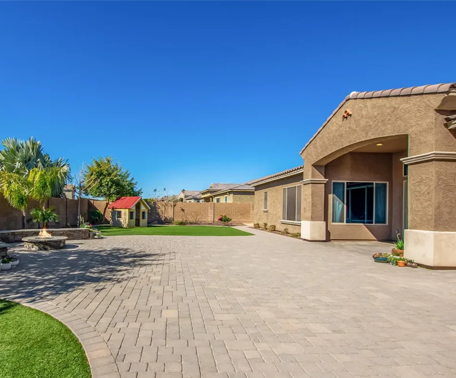
When you’re designing a family-friendly backyard, especially in Queen Creek, Gilbert, and the Arizona East Valley; the most important starting point isn’t the materials or the layout. It’s your purpose.
A great landscape design reflects how your family actually uses your space… not how you wish you used it.
Many homeowners begin with the idea of “a big yard for the kids,” or “lots of grass so they can play,” but the truth is that kids and pets use the yard very differently depending on their age, personality, and your lifestyle. The key to a beautiful and functional yard is understanding your reality, and designing around it.
Here’s how to create a landscape that supports your kids, your pets, and your long-term needs
Most parents design their yard based on how they hope their kids will use it. But smart design considers how your family behaves right now.
Ask yourself:
Many people imagine a big area of turf with a play structure in the corner. But here’s the reality:
Designing around reality ensures your budget goes exactly where it will get used.
Most play structures cost $5,000–$7,000, but they are typically only exciting for kids from ages 3–5. By 6 or 7, most kids have outgrown them.
Before you commit that budget, ask:
“Will my kids still use this in 5 years?”
For the same cost, you could install:
Your investment stretches much further when you think long-term.
Smart family-friendly design evolves with your children.
For younger kids (2–6):
For growing kids (7–11):
For teens:
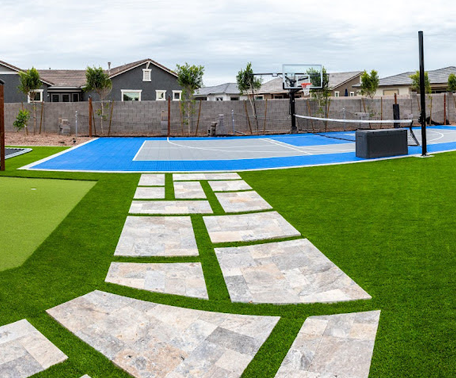
A small backyard usually isn’t big enough for a “sports field,” but it is perfect for sport courts.
A sport court can support:
These multi-use surfaces stay relevant long after a play structure becomes irrelevant.
If your family spends time outside in the summer, comfort should be part of your design.
Consider:
The right design keeps your yard usable all year, not just in the cool months.
If your yard will get a lot of use—from foot traffic, sports, or swing sets—you need a turf with a high face weight and strong backing. Cheaper turf (especially low-quality imported turf) flattens fast, wears quicker, and breaks down.
For family-heavy use:
Quality turf can last 20+ years when installed and chosen properly.
A pet-friendly yard starts with understanding your animal’s habits, not just adding turf or plants and hoping for the best.
Questions to consider:
These answers determine almost everything about your design.
Bathroom Placement Matters
Don’t put:
Artificial Turf for Dogs
If your dog uses turf for bathroom needs:
This keeps your yard clean, odor-free, and low-maintenance.
Plant Selection
If your dog eats plants, avoid:
There are dozens of pet-safe options that still fit Arizona desert landscaping beautifully.
Fencing and Separation
If your dog struggles with guests or delivery drivers, design in:
Functional design keeps everyone safe and reduces stress.
Your outdoor space should work for your family, not just look good in photos.
When designing for kids and pets, smart planning focuses on:
✔ How your family actually uses the space
✔ Future behavior as your kids grow
✔ Safety for kids and animals
✔ Comfort in Arizona heat
✔ High-quality materials that last
✔ Long-lasting play and activity zones
✔ Thoughtful pet accommodations
At Copper Ridge, we help families create outdoor spaces that are beautiful, functional, and built for real life—because your yard should evolve with your family, not against it.

We’re Now Copper Ridge Landscaping & Design! ELM Landscaping & Design is rebranding to Copper Ridge Landscaping & Design. Same trusted team and ownership. Same licensed, bonded, and insured company, proudly serving you for over 25 years. Thank you for growing with us!